
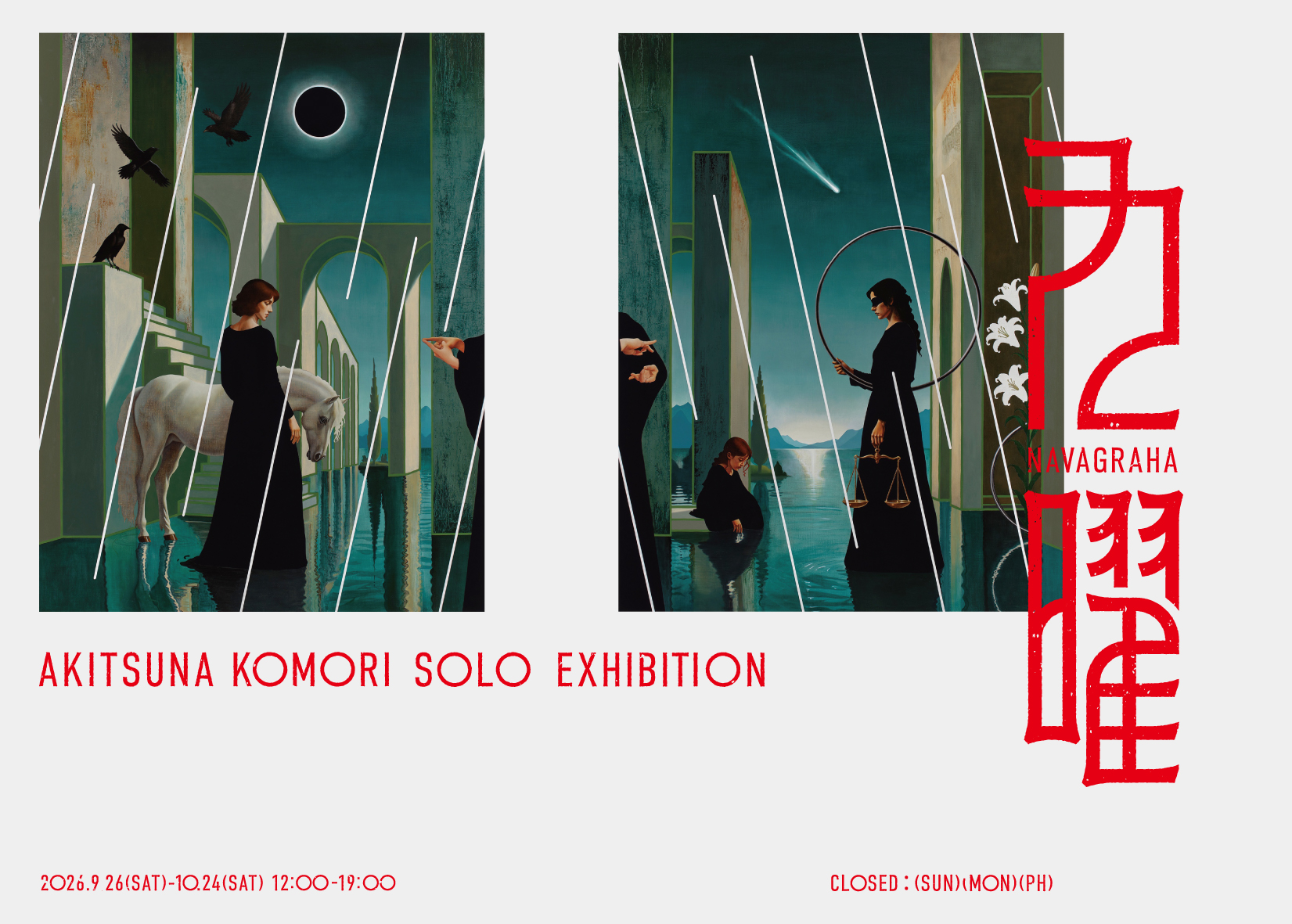
Akitsuna Komori solo show “Navagraha”
HENKYOでは、9/26(土)より小森紀綱による個展
「九曜 – Navagraha -」を開催いたします。
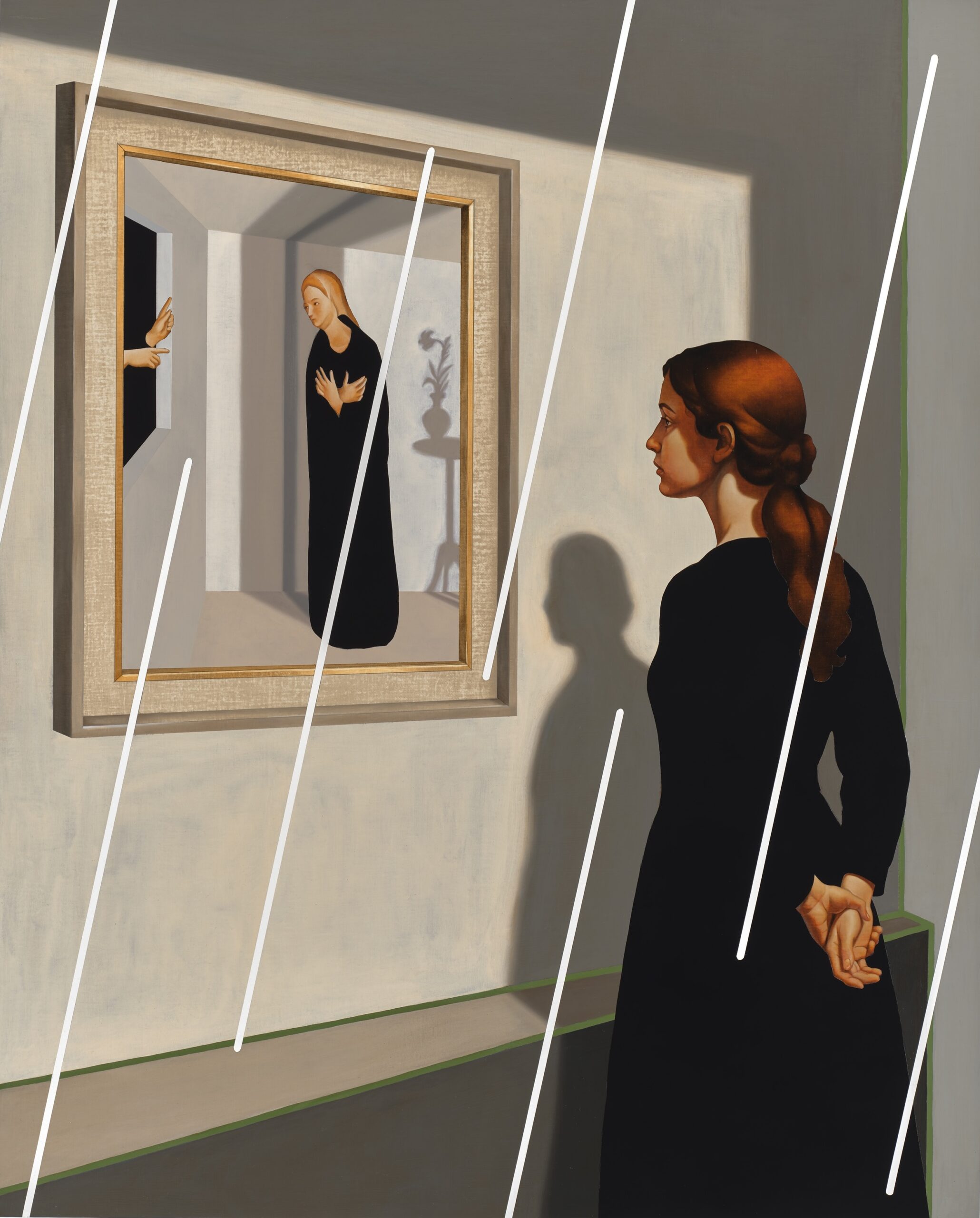
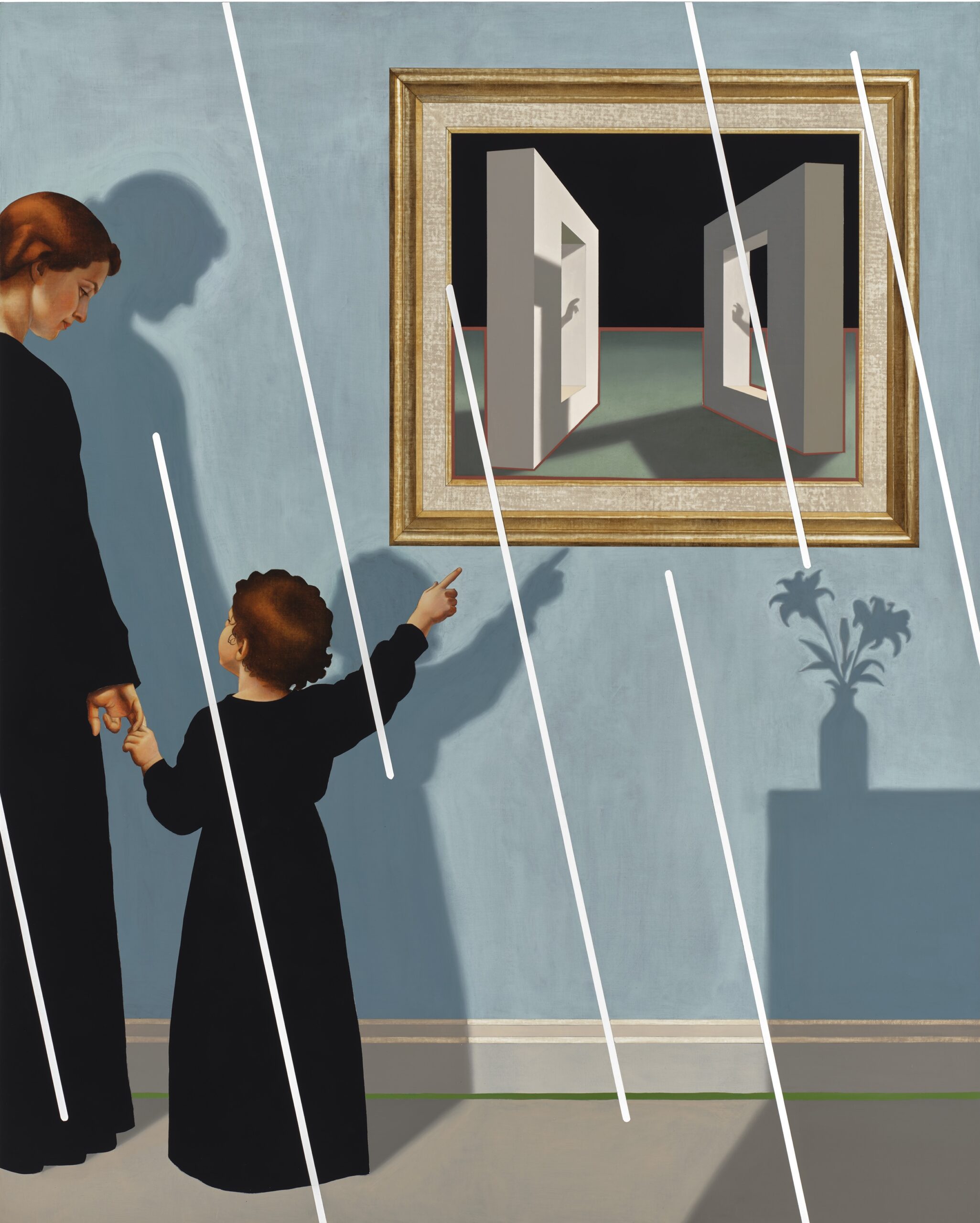
2年ぶりの個展となる本展では、小森の代表的なモチーフである”黒衣”や”雨”を用いた油彩画、フレスコ画などの新作約15点が並ぶ。
是非ご高覧ください。
【ステートメント】
古代の人々は天体の運行のなかに世界の秩序を見出した。
太陽や月、惑星の動きは単なる自然現象ではなく、人々の運命や国家の盛衰、季節の循環と結びついた宇宙の法則として理解されていた。古代のインド天文学における九曜はそのような秩序を読み解こうとする試みの一つであった。
現代の私たちは膨大な情報とアルゴリズムの流れの中に生きている。私たちが日々接する情報の多くは、複雑な計算と統計によって選別され、無数の判断や選択を静かに方向づけ、私たちの日常に浸透し、世界の見え方そのものを規定している。その多くは目に見えない。しかし確かに私たちの行動や価値観、人間関係や社会の在り方にまで影響を与えている。九曜において羅喉・計都が実体を持たない影の星でありながら日食や月食をもたらす存在であったように、現代社会にもまた実体を持たない無数の力が存在している。それらはときに人々を結びつけ、ときに分断しながら、社会の輪郭を形作っている。
本展では九曜を単なる古代の信仰体系としてではなく、人間と世界の関係を映し出すひとつの模型として捉える。
かつて人々が星々の運行のなかに世界の法則を読み取ったように、私たちもまた目に見えない何かによって世界を理解し、行動し、生きている。九曜と現代社会を重ね合わせることで、変わり続ける世界のなかに潜む普遍的な構造の輪郭を探りたい。
|
この度、画家の千住博さんから、小森紀綱 個展『九曜』の展評をいただきました。
小森紀綱さんの個展に寄せて/千住博(画家・日本芸術院会員)
小森紀綱さんの作品全てに重く存在する黒い色。それは画面のバランスを意識的に崩すほどの暗黒だ。私はそれを見て、現代天文学が到達した理論上の仮説、ダークマターを感じた。光学的に観測できない、全ての色彩を吸収してしまう全くの暗黒だが、質量を持つ。小森さんはそれを描いている、と感じ、戦慄した。
ダークマターにより光は曲げられ、全てはあるバイアスの元に見える様になる。このことを重力レンズ効果というのだが、その宇宙の歪みによって小森さんに見えてきた世界は、見えないものを見える様にしてきた宗教絵画のシーンに重なる。まるで宗教絵画が、ずっと昔からその様なことを描き出そうとしてきたかのように。
それは時に衣服として顕現する。また時としてそこにあるはずの青空の代わりに昼の空を支配する。常に、無意識のうち、私たちがそれらに包まれていると作品は語りかけているようだ。
小森さんの作品に描かれたものが宇宙的ダイナミズムの極致だとすると、作品を通してもうひとつ頭に浮かぶものがあった。それはインド仏教のマハーヴァイローチャナだ。それを弘法大師空海は大日如来として日本に紹介した。目に見えないが、この世界の全てを満たし、形作る根本的な宇宙の真理。精神的ダイナミズムの究極と言っていい。まるで無重力の宇宙空間に再現されたビジョンのような小森さんの作品世界は、現代の最先端天文学と7世紀に遡る真言密教の根本概念のクロスオーバーを感じさせる。
具象絵画にできる可能性は無限だ。それを小森さんは突き進み始めた。この素晴らしい才能の出現に私は目を見張っている。更に深めて、現代世界のアートシーンを代表できる芸術家に育ってほしい。
HENKYO is pleased to announce the solo exhibition “Navagraha” by Akitsuna Komori, opening Saturday, September 26, 2026.
Marking Komori’s first solo exhibition in two years, the exhibition presents approximately 15 new works, including oil paintings and frescoes featuring some of the artist’s recurring motifs, such as “black garments” and “rain.”
An opening reception will be held on Friday, September 25, from 7:00 PM.
We warmly invite you to join us and experience the exhibition.
Statement
Since ancient times, people have sought to find an order in the movements of celestial bodies.
The movements of the sun, moon, and planets were understood not simply as natural phenomena, but as manifestations of cosmic laws connected to human destiny, the rise and fall of nations, and the cyclical nature of the seasons. In ancient Indian astronomy, the Navagraha was one such attempt to decipher this cosmic order.
Today, we live amid vast flows of information and algorithms. Much of the information we encounter every day is filtered through complex calculations and statistical processes, quietly guiding countless judgments and choices. It permeates our everyday lives, shaping not only what we see, but also the way we perceive the world itself.
Much of this influence remains invisible. Yet it undeniably affects our actions and values, our relationships, and even the way society is structured.
In the Navagraha, Rahu and Ketu were regarded as shadow planets without physical form, yet were believed to bring about solar and lunar eclipses. In a similar way, contemporary society is shaped by countless forces that have no tangible form. At times connecting people, and at times dividing them, these invisible forces define the contours of the society in which we live.
This exhibition approaches the Navagraha not simply as an ancient system of belief, but as a model through which to reflect on the relationship between human beings and the world.
Just as people once sought to read the laws of the world through the movements of the stars, we too understand, act, and live through forces that remain largely invisible to us.
By bringing the Navagraha into dialogue with contemporary society, this exhibition seeks to trace the contours of universal structures embedded within an ever-changing world.
|
We received a review of Akitsuna Komori’s solo exhibition from artist Hiroshi Senju.
In Response to Akitsuna Komori’s Solo Exhibition
Hiroshi Senju / Painter, Member of the Japan Art Academy
The color black exists with a profound presence throughout Akitsuna Komori’s works. It is so absolute that it seems almost to delicately disrupt the balance of the picture plane. When I encountered it, I was reminded of dark matter, the theoretical hypothesis proposed by contemporary astronomy. Invisible to optical observation, it is a total darkness that absorbs all colors, yet possesses mass. I was struck by a sense of awe—and even terror—at the thought that Komori was painting precisely this.
Light is bent by dark matter, causing everything to appear distorted. This phenomenon is known as gravitational lensing. The world that comes into Komori’s view through such a distortion of sight seems to seek to make the invisible visible. It is as though religious painting had been attempting to depict such a phenomenon since long ago.
At times, this darkness manifests itself as clothing. At other times, it comes to dominate the daytime sky, replacing the blue sky we expect to see. His works seem to speak to us constantly and unconsciously of the fact that we are enveloped by these forces.
If what Komori depicts in his works can be understood as the culmination of cosmic dynamism, another image also came to mind as I encountered his paintings: Mahāvairocana in Indian Buddhism. Kūkai, the founder of Shingon Buddhism in Japan, introduced this figure to Japan as Dainichi Nyorai. Invisible yet permeating and shaping everything in this world, it represents a fundamental cosmic truth. It could be described as the ultimate form of spiritual dynamism. Komori’s world, which appears almost like a vision recreated within the weightless expanse of outer space, evokes a crossover between the very forefront of contemporary astronomy and the fundamental concepts of Shingon esoteric Buddhism, whose origins can be traced back to the seventh century.
The possibilities of figurative painting are infinite. Komori has begun to pursue those possibilities with determination. I am deeply impressed by the emergence of this remarkable talent. I hope that he will continue to delve deeper and develop his ability to express the contemporary art scene on the world stage.